
Rhinoceros Hornbill
Buceros rhinoceros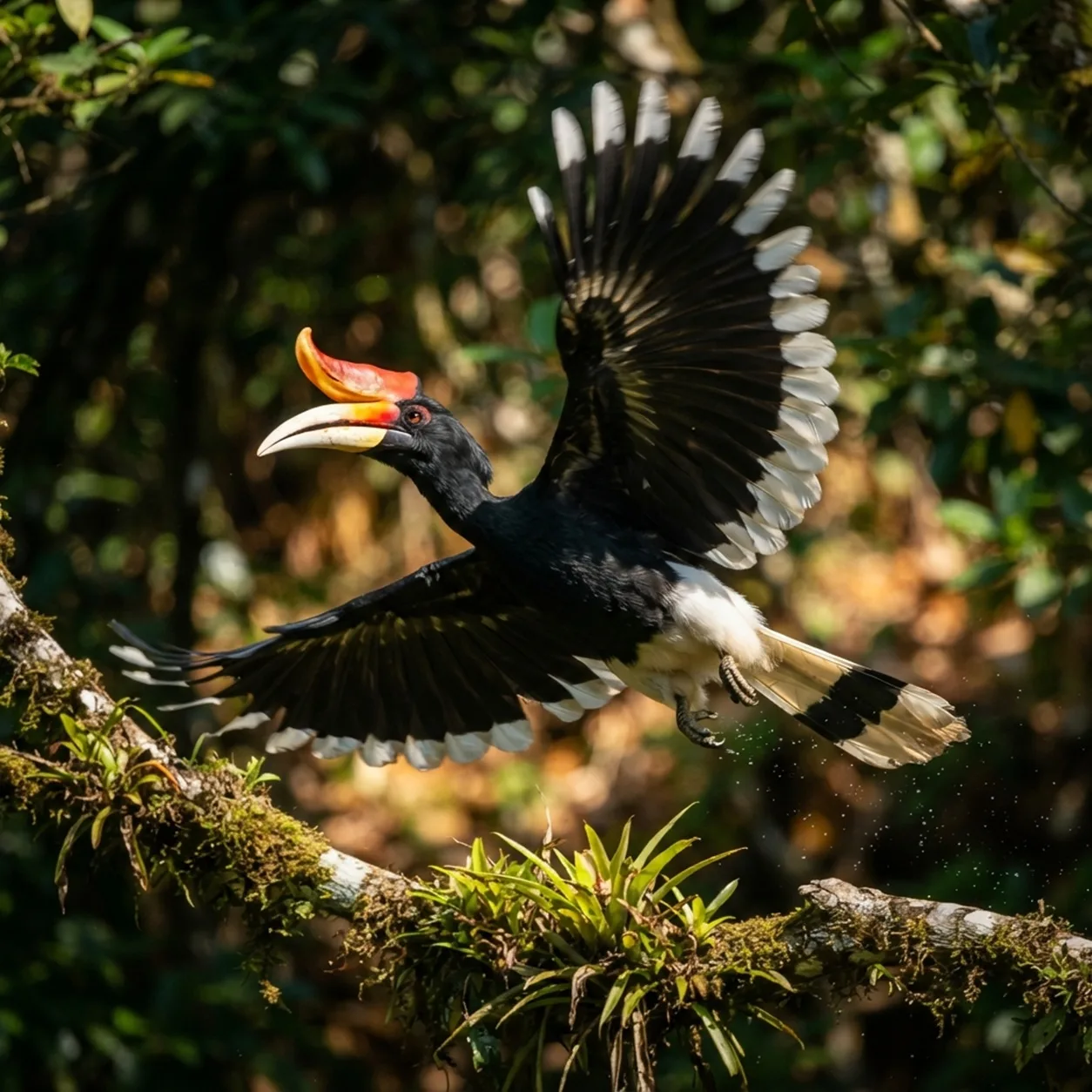
Hornbills
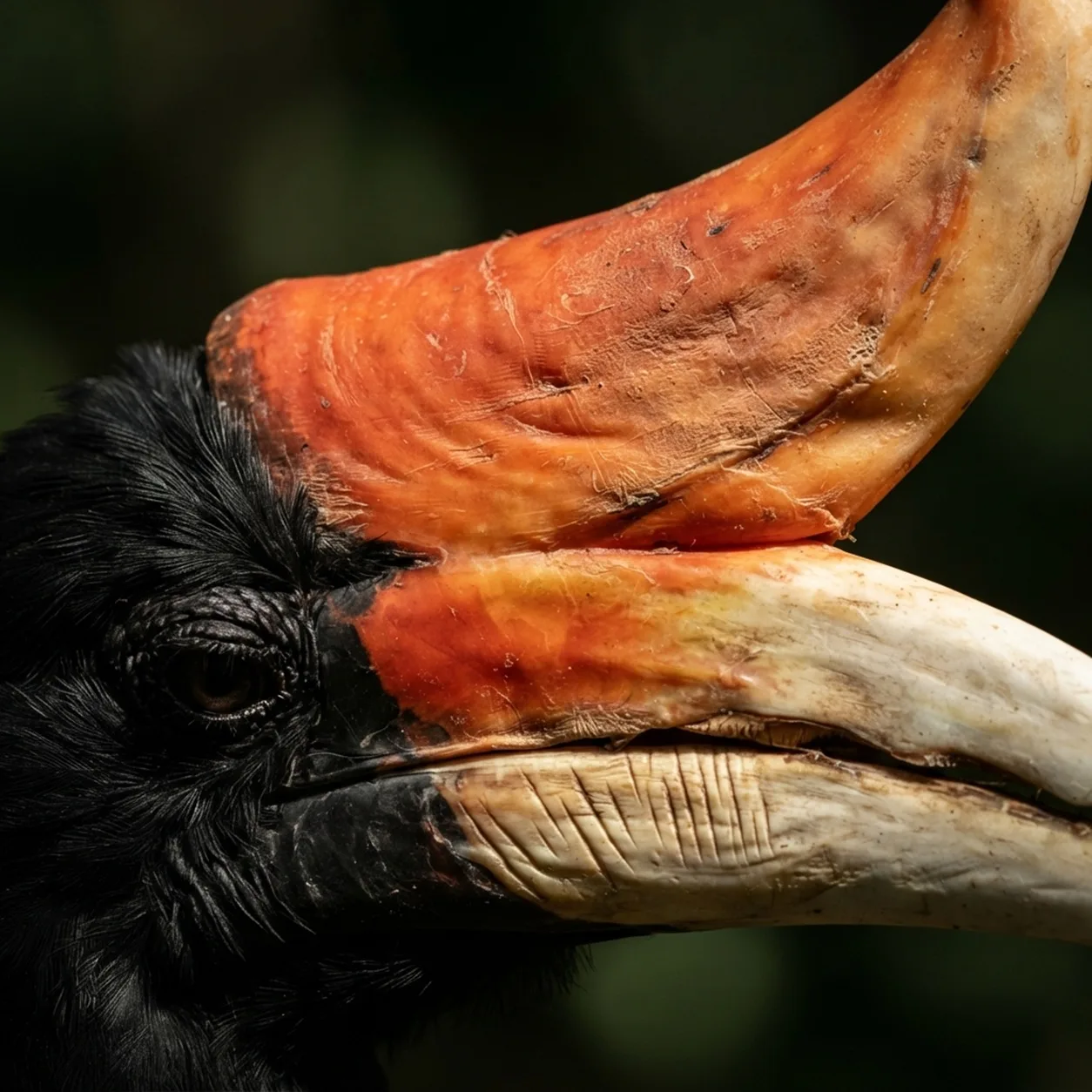
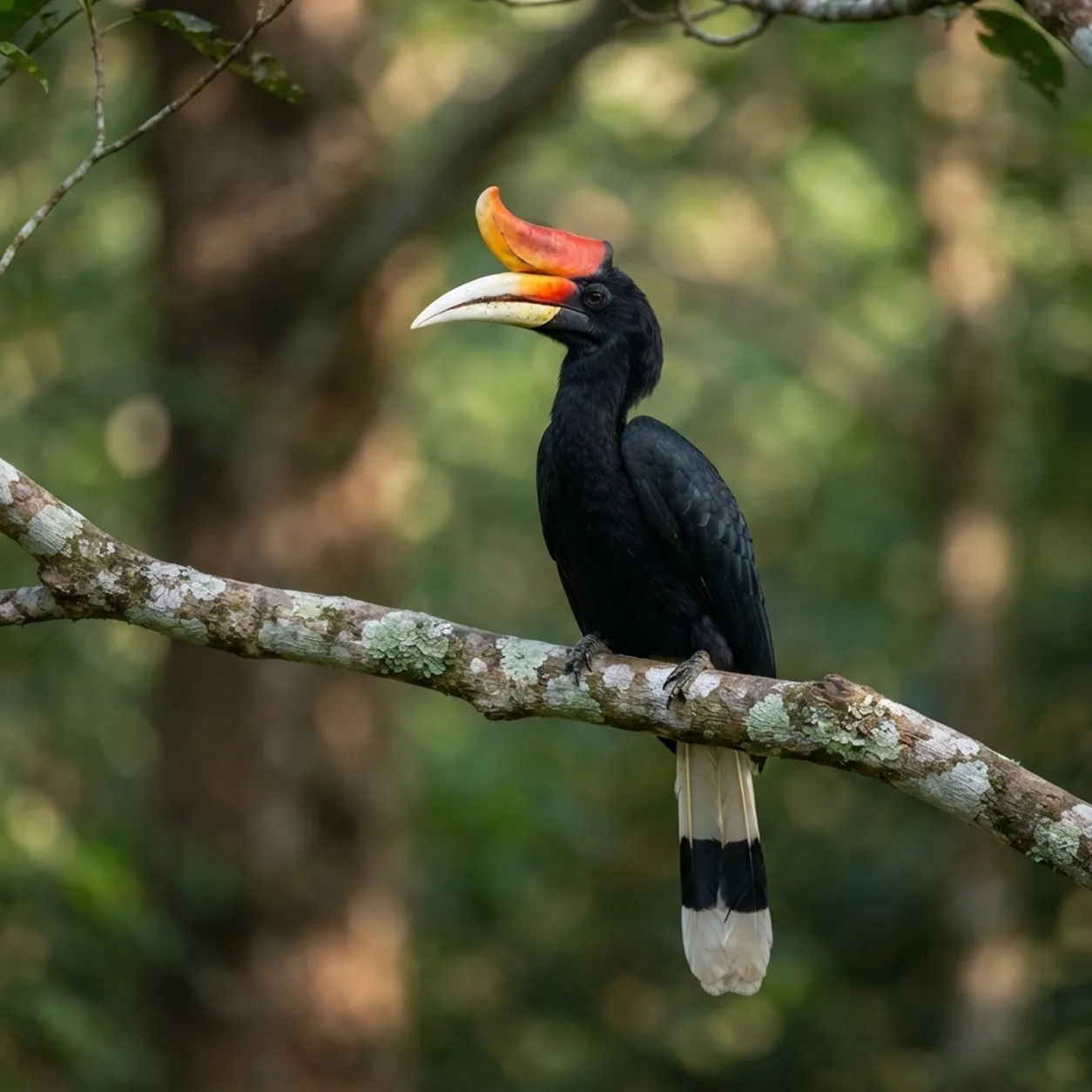
A large head, orange and red, growing curved up above a strong beak
The rhinoceros hornbill (Buceros rhinoceros) is a large arboreal bird belonging to the hornbill family (Bucerotidae), famous for the prominent, brightly colored, horn-like casque on top of its bill. Native to the tropical rainforests of Southeast Asia (including Borneo, Sumatra, Java, the Malay Peninsula, and southern Thailand), it plays a crucial role in its ecosystem as a seed disperser.
Physical Characteristics
- Size and Weight: Adults measure 80 to 90 cm (31–35 in) in length, with a wingspan nearing 5 feet. Males weigh approximately 2,465 to 2,960 g (5.4–6.5 lbs), while females are slightly smaller at 2,040 to 2,330 g (4.5–5.1 lbs).
- Plumage: Predominantly black body feathers, featuring a white tail crossed by a broad black band, and white thighs and vent.
- Bill and Casque: Features an enormous orange-and-red bill topped with a hollow, lightweight keratin casque. The bright coloration comes from preen oil rubbed onto the bill from a gland near the tail.
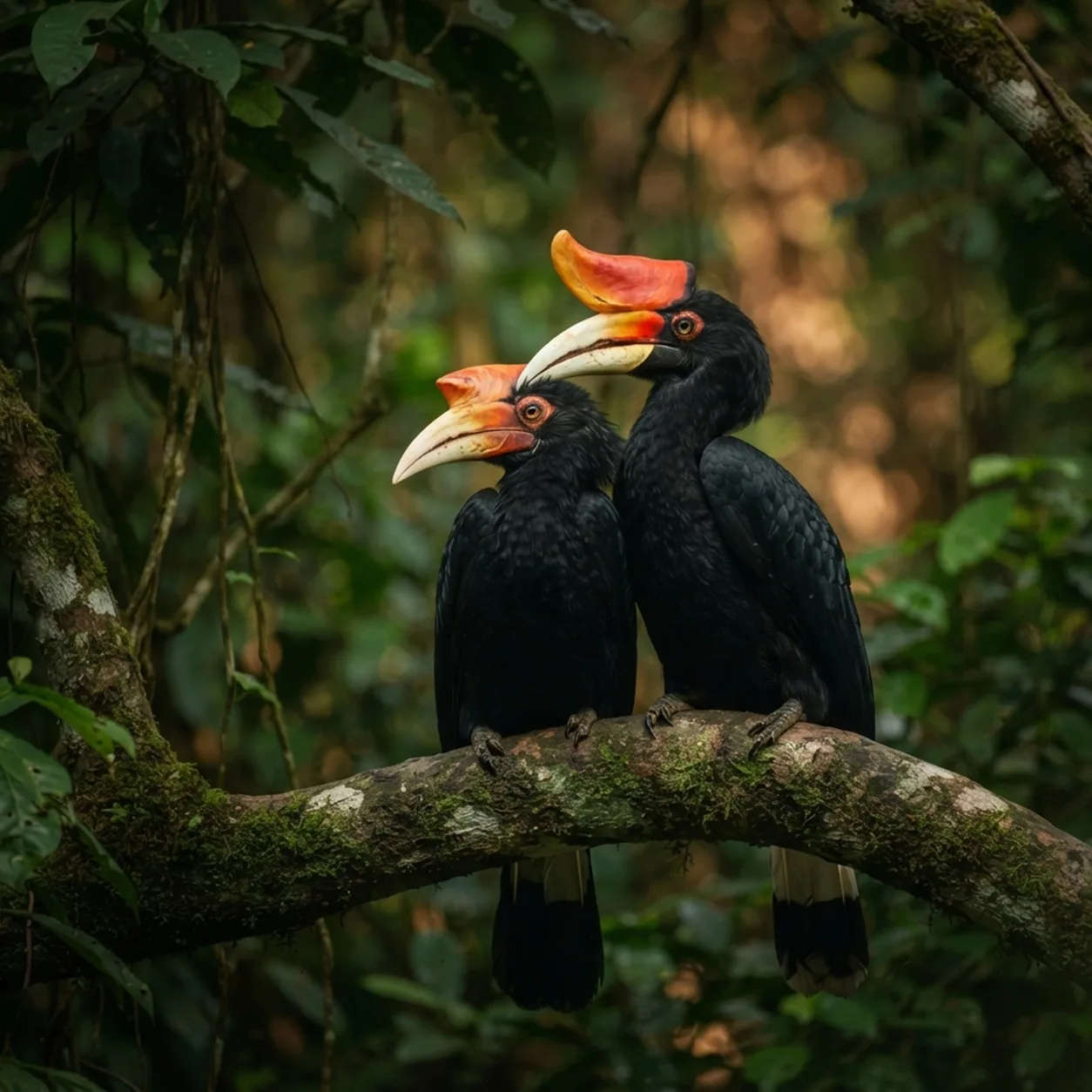
- Sexual Dimorphism: Males possess red eyes with black rims and an upswept casque tip, whereas females have white or whitish-blue eyes with a shorter, more rectangular casque.
Habitat and Distribution
- Geographic Range: Found in the Sundaic subregion of Southeast Asia, specifically Malaysia, Indonesia (Borneo, Sumatra, Java), southern Thailand, and parts of Brunei.
- Elevation: Inhabits primary lowland and hill dipterocarp rain forests, extending into tall secondary forests and montane zones up to 1,400 meters (4,593 feet).
- Ecological Role: Acts as an essential frugivorous seed disperser, helping regenerate old-growth rainforest trees through swallowed or regurgitated seeds.
Behavior and Diet
- Diet: Consists primarily of fruit (heavily favoring figs), supplemented opportunistically with insects, small reptiles, rodents, tree-frogs, and smaller bird eggs.
- Vocalizations: Emits loud, far-carrying, trumpet-like or honking calls (such as a disyllabic "ger-ronk" or "roh-ow"), which are heavily amplified by the hollow casque serving as a resonating chamber.
- Nesting Habits: Monogamous birds that mate for life and nest inside natural tree cavities high off the ground. The female seals herself inside the cavity using mud, droppings, and fruit pulp, leaving only a tiny slit. The male regularly regurgitates and passes food through the slit to feed the mother and developing chicks.
Cultural Significance and Conservation
- Cultural Status: Regarded as the national bird of Malaysia and the official state animal (or bird) of Sarawak, where indigenous Dayak communities traditionally view it as the chief of birds and a spiritual messenger linking earth to heaven.
- Conservation Status: Listed as Vulnerable / Near Threatened on the IUCN Red List due to accelerating tropical deforestation, commercial logging, and localized poaching for feathers, casques, and traditional use.
- Group
- Hornbills